
Thyroid Eye Disease - Management & Surgery
Ocular involvement (ophthalmopathy) is not uncommon in patients with thyroid disease. In these patients, the thyroid status can be quite variable. Whilst the majority are hyperthyroid, some are hypothyroid and a few are euthyroid. Indeed in some cases it may be difficult to demonstrate any thyroid abnormality at all. Due to the complexity of the condition, the need for careful management of any underlying thyroid dysfunction, the potential threat to vision and the toxic side effects of many of the therapies, close cooperation between an ophthalmologist and an endocrinologist is required. Ideally both should have a special interest in thyroid eye disease and there is a strong case for seeing these patients in a joint clinic so that medical and surgical management can be carefully coordinated.
A European survey by Weetman & Wiersinga2 showed considerable variation in practice with regard to the investigation and management of these cases. Thus it is not surprising that there is no consensus on when to use steroids, immuno suppressants, orbital radiotherapy, thyroid or ocular surgery. This makes it even more important for physician and surgeon to work closely together. We report our approach to the joint management to these cases.
1. Kendall-Taylor P. Current Management of Thyroid-Associated Ophthalmopahty. Clinical Endocrinology 1998. 49:11-12.
2. Weetman A & Wiersinga WMM. Current Management of Thyroid-Associated Ophthalmopathy in Europe. Results of an International Survey. Clinical Endocrinology 1998. 49: 21-28.
Clinical Assessment
To assess the activity and grade the disease accurately, an initial examination needs to be followed by a clinical review two to three months later. At the initial visit each new patient requires a full medical assessment by the endocrinologist. The ophthalmologist performs an ocular examination, which includes an orthoptic assessment (field of binocular single vision, field of uniocular fixation, Hess chart and visual field study), Snellen visual acuity and Ishihara colour vision assessment. Exophthalmometry is performed. Orbital tension, lid lag and lid retraction, corneal exposure, conjunctival venous flow, intraocular pressure in primary gaze and elevation, pupils and optic discs are then assessed.
Activity & Staging
It is important firstly to assess disease activity and stage the disease process. An indication of activity is provided by the Mourits score1. This gives a value to each of the following signs and symptoms; orbital pain or pain during ocular movement, redness (eyelid or conjunctiva), swelling (proptosis, lid oedema, chemosis or caruncle oedema), limitation of ocular movements, and visual dysfunction (acuity, field and colour). Of a total of 10 scores, patients with a score of 3 and higher and/or an increasing score on follow-up are judged to be active.
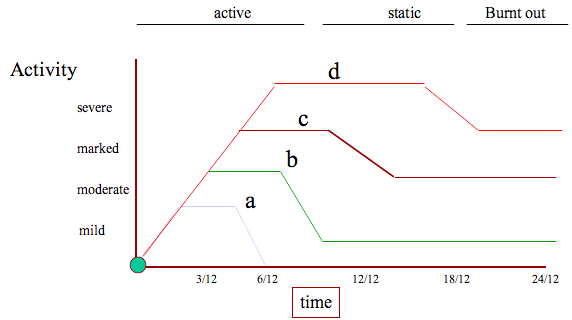
We also routinely use Rundle staging to record the severity of the ocular involvement2. Grade 1 (mild) ophthalmopathy can present with ocular discomfort, transient oedema and mild proptosis (Rundle a). The duration is typically two to four months and it normally resolves with no sequelae. Grade 2 (moderate) ophthalmopathy includes eyelid retraction, conjunctival oedema, ocular ache and moderate proptosis (Rundle b). Grade 3 (marked) ophthalmopathy presents with ocular motility disturbance with diplopia, chemosis and marked proptosis (Rundle c). This develops over six to twelve months and often leads to persistent diplopia and proptosis. Grade 4 (severe) ophthalmopathy presents with optic nerve dysfunction with reduction of colour vision and visual acuity loss (Rundle d). After 12 to 24 months patients may be left with optic nerve damage, double vision, lid retraction and proptosis. This is a serious eye condition with a considerable threat to vision.
1. Mourits MP, Prummel MF, Wiersinga WM, Koornneef L. Clinical Activity Score as a Guide in the Management of Patients with Grave's Ophthalmopathy. Clin. Endocrinol (Oxf). 1997; 47(1): 9-14.
2. Rundle FF. Eye Signs of Grave's Disease. Pitt-Rivers R, Trotter WR, Et al. In: The Thyroid Gland. London, Butterworths 1964, Vol.2: 171.
Investigation
If thyroid ophthalmopathy is suspected, there should be a full assessment of thyroid function. This would normally include measurement of serum free thyroxine (FT4), thyroid stimulating hormone (TSH) and anti-thyroid antibodies, e.g. anti-thyroid peroxidase (TPO) antibodies. Many centres also measure free triiodo-thyronine (FT3) to give a more complete picture of thyroid function. If all of these tests are normal or negative, it is sometimes appropriate to measure thyroid-stimulating antibodies but this is a specialist test available in only few centres. Full blood count, ESR, CRP, Chest X ray and Sinus X ray may also be indicated.
Orbital imaging includes MRI and CT scan. MRI (T2-weighed including fat suppression STIR Sequence) helps to identify high signals in an active extra-ocular muscle1. An orbital CT scan aids the diagnosis and assists the surgeon during decompression.
Follow-up assessment is usually at 3 to 4 months and includes weight and blood pressure measurement, urinalysis and thyroid function tests. Patients treated with steroids and/or immunosuppression will also need a full blood count, blood glucose, urea and electrolytes and liver function tests. MRI may be repeated in order to assess the effect of immunosuppression.
Conclusion
The management of patients with thyroid ophthalmopathy is complex and challenging. The evidence base is weak for the long-term effectiveness of many currently used interventions. However there is general agreement that careful control of any associated thyroid dysfunction is mandatory. Moreover, many of the non-surgical therapies can have serious metabolic and haematological side effects. For these reasons we feel that the concept of a joint ophthalmology – endocrine clinic has much to commend it. It certainly works well in Norwich and is much appreciated by our patients.
Bijan Beigi, MD FRCS FRCOphth, Consultant Ophthalmic Surgeon
Richard Greenwood, FRCP, Consultant Endocrinologist
The authors would like to thank Mr Nick Astbury for his input.
Book a Consultation
Interested in this treatment? Book a consultation with Mr. Beigi to discuss
DiscussOr call us directly
01603 324545
Ready to Transform Your Skin, Face, or Body?
Book a consultation with one of our qualified practitioners to discuss Thyroid Eye Disease - Management & Surgery and create a personalised treatment plan.